


1. 서 론
국내 하수도 인프라가 지속적으로 발전됨에 따라 청천 시에는 효율적이고 안정적인 하수처리가 가능한 시스템을 갖추게 되었다. 그러나 강우 시 하수시설물 관리를 위한 투자나 서비스는 초기 단계로써 향후 하수도 인프라는 강우발생 시에도 안정적인 처리를 할 수 있도록 꾸준한 투자가 필요한 상황이다.
분류식 하수관로 시스템에서 발생한 월류수인 Sanitary Sewer Overflows (SSOs) 문제를 해결하기 위한 대표적인 가이드라인 중 하나인, 미국 환경청(USEPA)의 Capacity, Management, Operation, Maintenance (CMOM) 프로그램은 하수관로의 용량부족 및 적절하지 못한 유지관리로 인해 유발 되는 SSOs 발생 문제를 해결하기 위하여 다양한 방법을 제시하고 있다(EAP, 2005). CMOM 프로그램은 하수관로 용량 부족에 의해 발생되는 분류식 하수관로 월류수의 주요 원인으로 판단 할 수 있는 변수로 침입수(Infiltration)와 유입수(Inflow)를 나타내고 있다. 침입수/유입수(I/I)는 강우사상인 강우빈도 및 강우량과 밀접한 관련이 있고, Rainfall-Derived Inflow and Infiltration (RDII)라 정의하고 있다(Zhang, 2007).
RDII의 경우 하수관로의 하수량 산정에 있어 중요한 요소로, 시뮬레이션에서 고려해야할 필수적인 요소 중 하나라고 볼 수 있다.
RDII량을 예측하는 방법으로 EPA (2008)는 합성 하천 유량 회귀 분석 방법(The Synthetic Streamflow Regression Method), 확률 방법(Proba-bility Method), 하천 유량 비율 방법(Percentage of Streamflow Method), 일정 강우량 비율 방법(Constant Unit Rate Method), 합성 단위 유량도(The Synthetic Unit Hydrograph Method), 강우 및 하수량 회귀분석법(Rainfall/Sewer flow Regression Method)의 6가지 계열로 분류했다. RDII 예측 방법 중 WERF (1999)는 회귀분석 방법과 합성 단위 유량도법이 가장 효과적이라고 하였다. 또한, 추가연구에서도 두 가지 방법을 활용한 RDII 예측모델의 정확도가 상당히 높은 것으로 제시하고 있다(Wright et al., 2001).
국내의 경우 환경부에서 국내 표준 침입수/유입수(I/I) 산정 매뉴얼을 제공하여 침입수/유입수(I/I) 산정 시 활용토록 하고 있으며, 이를 기준으로 침입수/유입수(I/I)에 대한 선행연구들이 다수 존재한다.
Kim et al. (1999)은 합류식 하수관로에서의 I/I량에 대한 발생 특성연구를 위해서 I/I 산정방법으로 침입수 평가방법에 대하여 최소유량 평가방법, 유량질 평가방법, 물 사용량 평가 방법을 적용하였고 강우 시 유입수량 평가방법으로 독립 유량 산정 방법을 이용하였다.
그러나 국내의 경우에는 단순하게 산술적 계산을 통해 침입수/유입수(I/I) 산정에 관한 방법과 절차에 대한 검토 및 연구만 수행하였을 뿐, 모델을 통한 RDII 발생량을 예측하는 연구는 활발하게 진행되지 않고 있다.
일부에서 회귀분석 방법을 통한 강우 시 RDII 발생량을 예측 하였으나, 강우 패턴 변동성 문제로급격한 강우에서는 모델의 재현성 확보의 문제가 대두되었다(Ryu et al., 2014).
기 수행된 연구 결과로는 강우사상에 따른 계측 및 미계측구간에 대해 유입수 특성분석 및 SSOs발생여부 판단에 한계가 있다.
본 연구에서는 Storm Water Management Model (SWMM) 모형 및 Sanitary Sewer Overflow Analysis & Planning (SSOAP) 도구를 이용한 강우사상에 따른 계측 및 미계측 차집관로 구간에 대한 유입하수량 특성을 분석하여 제시하였다.
2. 모형의 개요
2.1 XP-SWMM 모형
XP-SWMM 모형은 미국 EPA SWMM의 기본엔진을 기반으로 하이드로소프트사에서 사용자가 쉽게 모형을 접할 수 있도록 그래픽 및 인터페이스등을 개발하여 윈도우화 한 것으로 SWMM과 동일하다고 할 수 있다.
도시유역 내에서 강우사상으로 인해 발생하는 지표면 및 지표하 흐름, 배수관망에 대한 유출량 추적, 저류지 모의, 과적(surcharge)흐름, 배수(back water), 압력류, 오염물질에 대한 처리 등을 모의할 수 있는 모형이다(Huber and Dickinson, 1988).
SWMM은 RUNOFF BLOCK, TRANSPORT BLOCK, EXTRAN BLOCK으로 구성 되어 있으며, 강우유출 해석방식에 따라 세 가지 BLOCK을 조합하여 부정류 해석이 가능하다.
SWMM 도시유역에 우수유출모의가 가능한 특화된 모형으로 강우조건의 경우 단일 및 연속강우사상에 대한 해석이 가능하며, 강우시간 간격 설정을 임의조건에서 가능하고, 또한 계산된 결과의 연산 처리 간격은 강우사상 조건에 따라 임의 조정이 가능하다는 장점이 있다.
본 연구에서는 SSOAP도구에서 산정된 R, T, K 매개변수를 RUNOFF BLOCK에 입력 후 수문학적 해석을 수행하였다. 또한 미 계측 차집관로 구간의 R, T, K산정을 위해 RUNOFF BLOCK을 적용하였다. 유입수량에 의한 관내 해석은 TRANSPORT BLOCK을 사용하였다.
2.2 SSOAP 도구
SSOAP 도구는 하수시스템에서의 강우 시 유입유량 예측을 위해 미국 환경청(USEPA)과 Camp Dresser & McKee Inc. (CDM)가 개발한 소프트웨어 패키지도구이다(EPA, 2008).
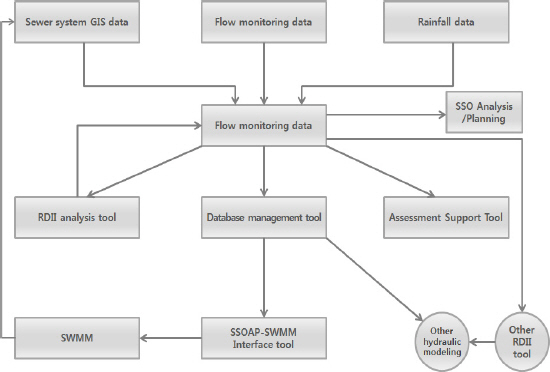
SSOAP 프로그램의 도구 상자는 분류식 하수도시스템에서 RDII 발생량을 예측 하고 통수능 분석을 쉽게 하기 위해 사용되는 컴퓨터 소프트웨어 툴을 의미 한다. SSOAP에는 분류식 하수도시스템의 수리학적 분석을 위해 SWMM을 이용 하는 옵션이 포함되어 있으며, 프로그램 아키텍처는 다양한 외부 데이터 소스, RDII 분석 도구 및 SWMM을 연결함으로써 효율적인 하수도 시스 템 용량 분석 및 계획을 가능하게 한다.
SSOAP 도구는 Borland Delphi® (2006 edition)을 사용하여 프로그래밍되어 있으며, Microsoft Windo ws® 환경에서 작동한다. Fig. 1은 SSOAP 도구 구성을 도시화한 것이다.
현재 하수관로에서 사용하는 대표적인 RTK방법은 미국 EPA SWMM모형에서 강우 유출 모형의 표준화된 방법으로 SSOs 발생량을 분석하기 위해 SSOAP에 적용 되고 있는 모델이다(EPA, 2012).
단위 강우량을 기준으로 3개의 중첩된 삼각형을 통한 단위 유량도를 표현하고 단일 강우에 유량도를 중첩시키는 방법이며, 각각의 삼각형 모형은 3가지의 변수인 R, T, K를 통해 결정된다. R의 경우, 하수관로에 실제 영향을 주는 강우량 비율, T는 첨두 유량값이 나타나는 시간, K는 첨두 유량에서 0까지 감소되는 T의 비율을 나타낸다(Vallabhaneni and Smith, 2014).
RDII 예측 프로그램(SSOAP)의 경우 여러 강우사상에서 R, T, K값을 예측하는 방식이며, 본 연구에서는 실제 발생 패턴과 예측한 패턴의 오차 및 재현성이 최소가 되는 시점까지 시행착오방법을 통해 예측해 가는 방법을 이용하였다.
3. 모형의 구축 및 검증
3.1 적용 대상지역 현황
본 연구에서는 과거 하수관거정비사업을 통한 완전 분류식지역 중 오수 및 차집관로를 대상으로 선정하였다. 합성단위유량도를 기반으로 RDII 예측모델을 검토하기 위해 국내에 위치한 W군의 SR처리구역을 대상으로 하였다. SR처리구역은 총 3개의 처리분구가 SR하수처리시설로 유입되어 처리된 후 MK 수계로 방류되고 있으며, 완전 분류식 지역이다. SR처리구역 면적은 총 3.997 km2이며, SR처리분구는 2.358 km2, BD처리 분구는 1.426 km2, YJ처리분구는 0.213 km2으로 구성되어 있다. SR처리구역 내 오수관로연장은 189.0 km, 우수관로연장은 87.7 km이고, 하수처리인구는 43,680명인 것으로 나타났다. Fig. 2는 W지역의 BD처리구역의 위치, 처리분구 경계, 오수 및 차집관로, 오수펌프장 및 하수처리시설위치를 나타낸다.

3.2 SWMM 모형의 구축
연구대상관로는 조사지점여건에 따라 지선 및 간선관로로 구분하였으며, 지선관로를 기준으로 청천 시 보정작업을 수행하였고, 보정작업이 완료된 관로의 경우 간선관로 구간에서 추가 보정 작업을 수행하였다.
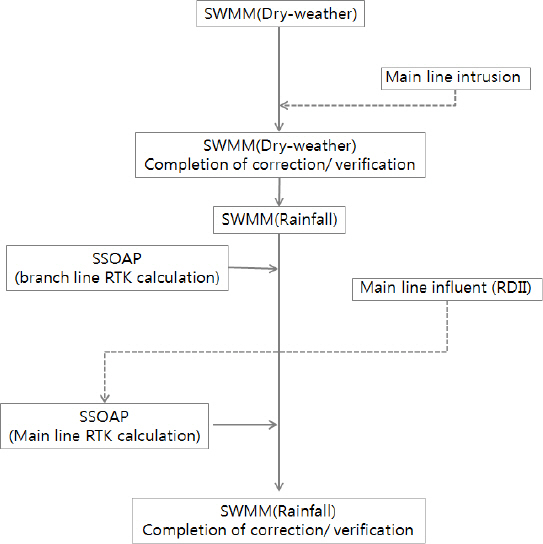
SWMM 모형 사용모드는 강우 시 유출해석을 위한 수문학적 인자에 관여하는 RUNOFF BLOCK와 관로 내 수리학적 거동분석을 위한 TRANSP ORT BLOCK를 사용하였다. 또한, 본 연구는 SSOAP 도구를 이용하여 R, T, K값을 시행착오법에 의해 산정하였고, 산정된 결과값을 SWMM 모형의 RUNOFF BLOCK에 입력조건인자로 활용하였으며, SWMM 모델의 구축절차는 Fig. 3과 같다.

SWMM 모형은 소유역별 수문학적 특성과 유출정보를 통해 강우사상의 변화에 따른 유출량의 동적흐름을 산정 할 수 있다. 그러나 본 연구에서는 강우에 의해 발생되는 RDII 발생량은 SSOAP 도구에서 분석하므로 SWMM 모형에서는 유역에 대한 정보는 모델 구동을 위한 최소한의 Default값만 입력한다. 그러므로 SWMM 모형에서는 RUNOFF BLOCK 구동을 위해 소유역 면적, 폭, 경사, 불투수비율 침투 및 저류 인자등을 입력하고 TRANSPORT BLOCK에서의 관로 내 하수량의 시간적 흐름분석을 위해 기본적으로 관로에 대한 조도계수, 관로규격, 연장, 경사, 관저고, 지반고 등을 입력한다.
본 연구지역의 하수도정비기본계획 자료 중 하수관로 대장도 및 수리계산서를 이용하여 오수 및 차집관로 현황을 Fig. 4와 같이 구축 하였다.

3.3 SWMM 모형의 검증
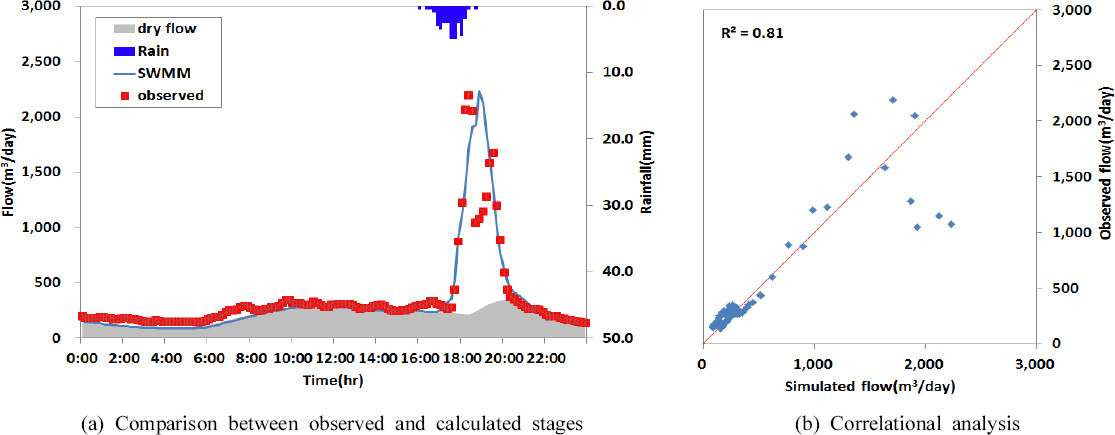
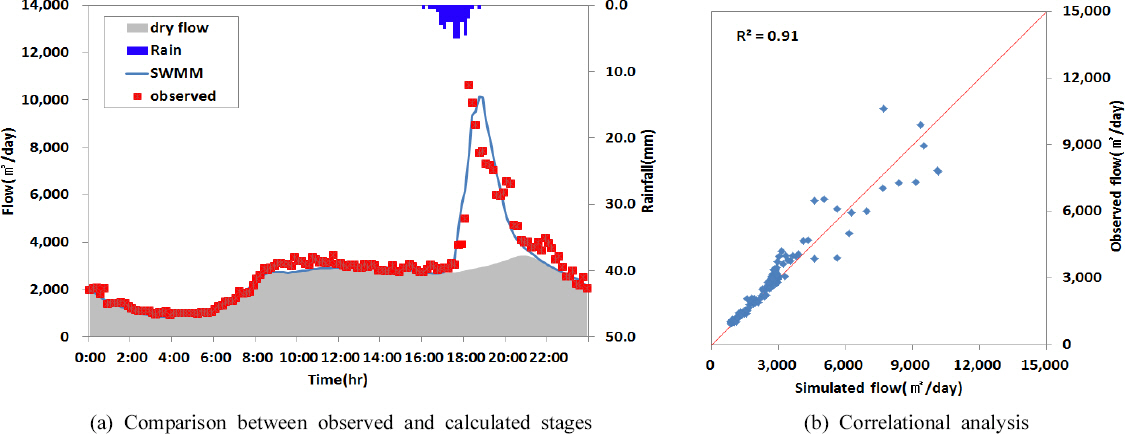
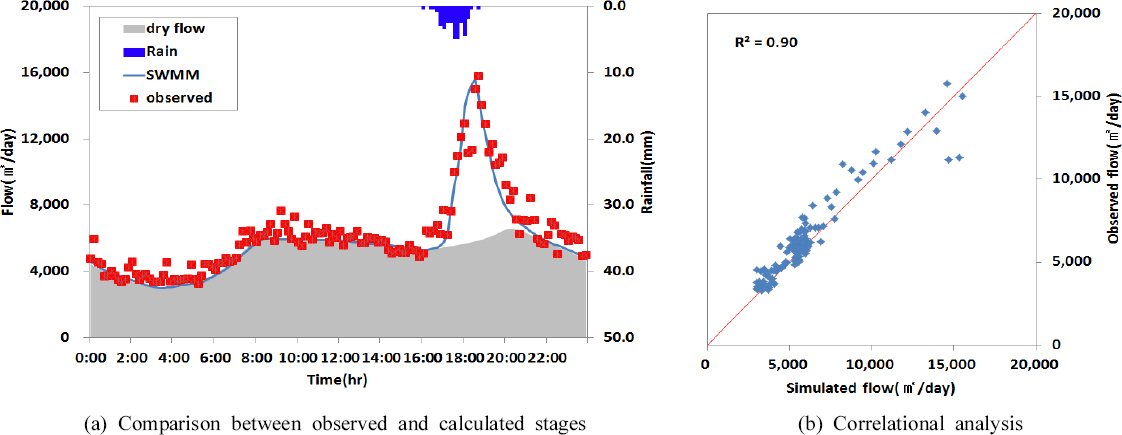
구축된 모형을 검증하기 위해 주요 지선 및 간선 차집관로에서 조사한 하수량의 유출특성 분석 결과를 바탕으로 RDII 발생량 최대값과 시간별 수문곡선의 형상을 중심으로 매개변수를 조정하여 보정 후 다른 조사 관측치를 이용해 최종적인 모형 구축 결과에 대해 검증을 실시하는 방법으로 수행 하였으며, 모형 검증 절차는 Fig. 5와 같다.
모형의 정밀도를 위해 27개 지점에 대해 2018년 7월 19일부터 2018년 9월 26일까지 총 70일간 하수량을 측정하였으며 조사지점은 Fig. 6과 같다.

본 연구기간동안 조사한 강우 시 하수량자료를 기준으로 SSOAP 도구의 합성단위유량도법을 이용하여 지선구간의 조사지점별 R, T, K 인자를 산정하였다. 또한, 차집 및 오수 간선관로의 상태평가를 위해 조사지점 구간을 지선(소유역) 및 간선관로로 구분하여 R, T, K값을 산정하였다. R, T, K 산정에 활용된 강우 이벤트는 12개이며 Table 1과 같다.
Table 1
Analysis of Rainfall Events during the Monitoring Period
또한 지점별 R, T, K 산정 시 활용된 강우 이벤트는 최소 2개에서 최대 8개 이벤트를 적용하였으며, Table 2와 같다.
Table 2
Rainfall Event with Calibration Applied
지선관로(소유역) 18개지점에 대한 R, T, K값 산정결과 강우이벤트에서 산정된 강우량 대비 관로내 강우유입수 비율을 나타내는 Total R은 0.3~8.5%로 나타났으며, BD1-3 지점과 SR3-1 지점에서 가장 크게 발생하는 것으로 분석되었고, Table 3과 같다.
Table 3
Calculation of R, T, and K Parameters for Branch Lines
지선관로에서 산정된 R, T, K값을 SWMM에 입력 후 총 12번의 강우 이벤트 중 RDII 발생 및 R, T, K 산정이 가능한(유효데이터 확보) 2개의 강우이벤트를 선정하여 간선관로 9개지점에 대한 R, T, K값을 산정하였다.
간선관로 9개지점에 대한 R, T, K값 산정결과 강우이벤트에서 산정된 강우량대비 관로내 강우유입수 비율을 나타내는 Total R은 0.3~4.7%정도로 나타났으며, BD1-2지점에서 가장 크게 발생하는 것으로 분석되었고 Table 4와 같다.
Table 4
Calculation of R, T, and K Parameters for Main Lines
또한 본 연구지역 하수처리구역의 R1 + R2 비율은 66.7~95.7%로 이는 하수관로의 구조적 불량을 나타내는 수치로 대변할 수 있어 하수관로 상태를 간접적으로 평가 할 수 있었다.
4. RDII 발생 특성 분석
4.1 단일 강우사상에 의한 RDII 발생량
단일강우사상에 의한 RDII 발생량평가를 위하여 검증을 통해 구축된 모델에 단일 강우사상(43.5 mm/12 hr)을 적용하여 RDII 발생량을 산정 하였으며, 청천 시 유입 하수량을 고려하여 분석하였다. 적용된 단일강우사상 발생 시 본 연구지역에서 발생되는 총 유입 하수량은 36,601.4 m3/d이며, 이 중 강우영향 불명수 RDII 발생량은 6,125.5 m3/d (지선: 1,873.6 m3/d, 간선 : 4,251.9 m3/d)로 산정되었으며, Table 5와 같다.
Table 5
Results of RDII Amount Generated by Single Rainfall
| Base Sewage | Infiltration | Rainfall-induced Infiltration | Sum | ||
|---|---|---|---|---|---|
|
|
|||||
| Branch sewer | Main sewer | Branch sewer | Main sewer | ||
| 8,600.4 m3/d | 7,969.9 m3/d | 13,905.6 m3/d | 1,873.60 m3/d | 4,251.9 m3/d | 36,601.4 m3/d |
본 연구 하수처리구역의 R1 + R2 비율은 66.7~95.7%로 이는 하수관로의 구조적 불량을 나타내는 수치로 대변할 수 있으며, 하수처리구역의 강우 시 발생하는 RDII 중 하수관로로 직접 유입 및 침입수의 비중이 큰 것으로 판단된다. 강우량대비 관로내 강우유입수 비율을 나타내는 Total R은 0.3~8.5%의 범위에서 분석되었다.
4.2 연속 강우사상에 따른 RDII 발생량 분석 결과
월별 강우량에 따른 RDII 발생량은 7월 강우발생량이 가장 큰 시기에 많이 발생하는 것으로 나타났으며, Table 6과 같다. Kim (2013)은 강우에 의한 유입수량은 우기인 7월, 8월, 9월에 가장 많이 발생하였으며, 강우량과 비례하여 발생하는 것으로 평가하였다.
Table 6
Results of Monthly RDII Amount Generated Calculation by Continuous Rainfall
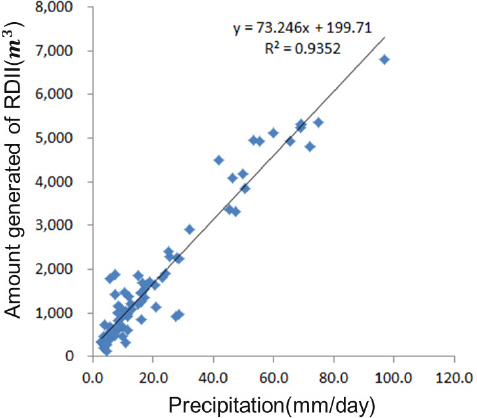
또한 강우량에 따라 RDII 발생량은 증가하는 것으로 분석되었으며, 상관계수는 0.9352로 상관성이 큰 것을 확인 할 수 있었으며, Fig. 10과 같다. 그러나 시간최대 강우량과 RDII 발생량과의 연관성은 크지 않는 것으로 분석되었으며, Table 7과 같다. 이는 본 연구지역의 하수관로 상태를 대변하는 R, T, K 매개변수에 의해 분석된 결과이므로 타 지역 관로상태에 따라 상이 할 수 있다. 그러므로 지역적 특성을 고려한 하수처리시설 설계 시 본 연구에서 제시한 것처럼 단일강우사상에 의한 강우영향 불명수(RDII) 산정방법을 도입 한다면 좀 더 효율적인 하수처리시설물의 설계가 가능 하다.
Table 7
Result of RDII Volume by Continuous Rainfall Thought
5. 결 론
본 연구에서는 분류식 하수처리구역의 오수 및 차집관로에서 발생되는 RDII 발생량을 SSOAP 도구의 합성단위유량도법을 이용하여 R, T, K 매개변수를 산정 한 후 SWMM 모형에 적용하였다. SWMM모형을 통해 단일 및 연속강우에서의 RDII발생량 및 발생특성에 대해 분석하였다.
대상지역의 강우특성분석을 통해 얻은 강우사상적용 시 구조적 불량 및 오접등에 의한 유입수의 특성을 반영한 유출 수문곡선을 산정 할 수 있다.
연속강우사상에 의한 강우지속시간별 RDII 발생량 산정 결과를 통해 강우량에 따라 RDII 발생량은 증가하는 것으로 분석되었으며, 강우발생량과 RDII 발생량과의 상관계수는 0.9352로 상관성이 큰 것을 확인 할 수 있었다. 그러나 시간최대 강우량과 RDII 발생량과의 연관성은 크지 않는 것으로 분석되었으며, 이는 본 연구지역의 하수관로 상태를 대변하는 R, T, K 매개변수에 의해 분석된 결과이므로 타 지역 관로상태에 따라 상이 할 수 있다.
본 연구에서 사용한 모형을 통한 RDII량 발생 특성 분석방법은 특정 강우사상이 아닌 다양한 강우사상에서의 유입수 특성분석을 수행하여 효율적 하수시설물 설계 시 이용 될 수 있다.


 PDF Links
 PubReader
 ePub Link
 Full text via DOI
 Download Citation
 Print
Print